
Mahāsuvanna Jataka
The Tale of the Golden Swan and the Covetous Merchant
In the vibrant city of Benares, nestled beside the sacred river Ganges, lived a merchant named Punna. He was a man of great wealth, his coffers overflowing with gold and jewels, but his heart was perpetually unsatisfied. Greed was a shadow that clung to him, whispering promises of more, always more. He possessed silks finer than spiderwebs, spices that perfumed the air for miles, and pearls that gleamed like captured moonlight, yet he yearned for what he did not have.
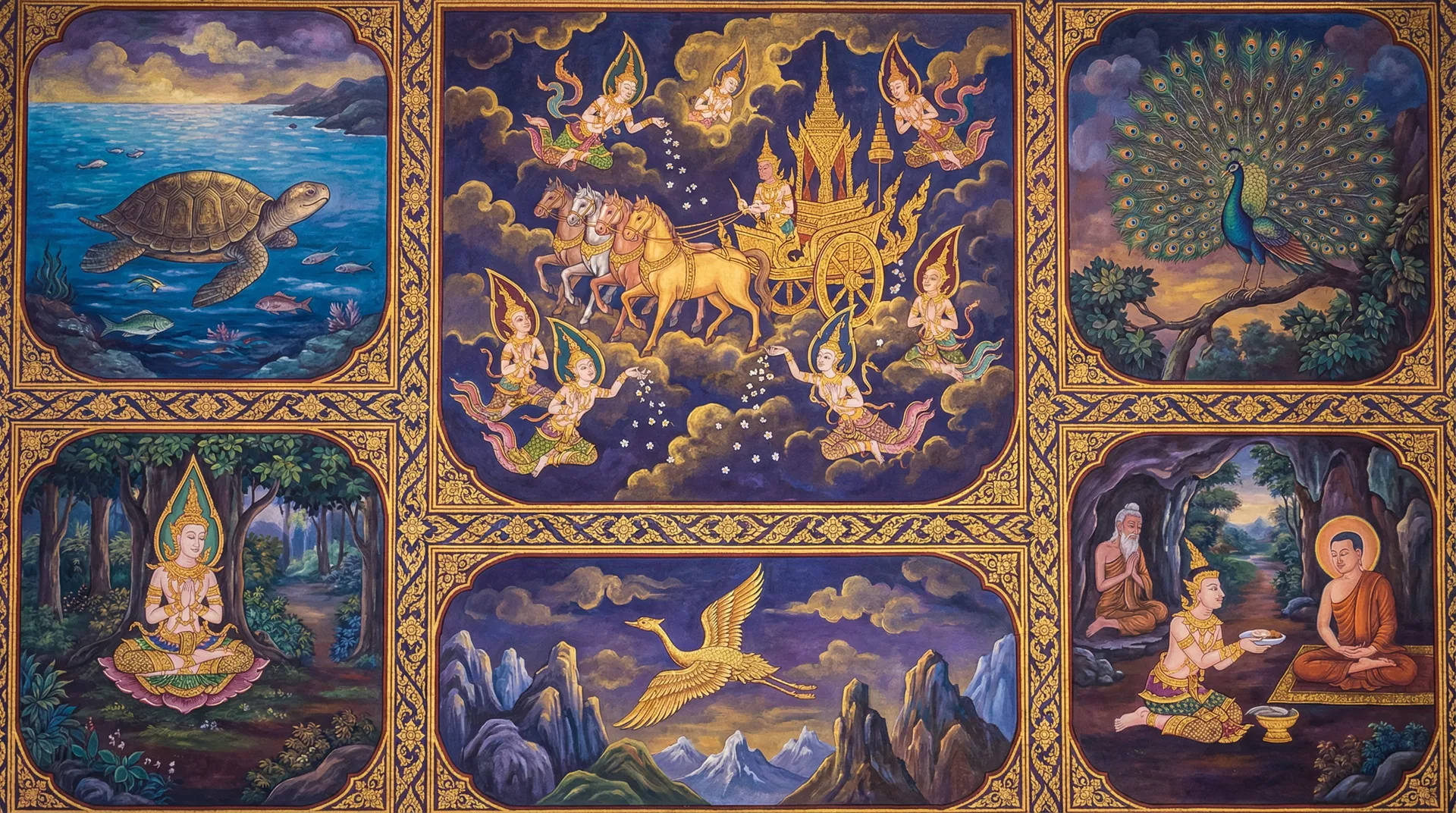
One day, a wondrous creature appeared in the royal aviary – a swan of pure, incandescent gold. Its feathers shimmered with an ethereal light, and its eyes sparkled like diamonds. The king, delighted by its beauty, declared it the most precious treasure in his kingdom. News of the golden swan spread like wildfire, reaching the ears of the insatiable merchant Punna.
Punna's mind immediately began to spin. He envisioned melting down the swan, forging its golden body into coins, and adorning his mansion with its feathers. The thought of such unimaginable wealth consumed him. He approached the king with a proposal. "Your Majesty," he began, his voice dripping with feigned admiration, "this golden swan is indeed a marvel. But I, Punna, have traveled the world and seen many such creatures. I know a place where they flock in abundance. If you allow me to take this one swan, I shall bring you back ten more, each brighter and more beautiful than this."
The king, though fond of his swan, was intrigued by the promise of more riches. He was also somewhat naive, believing Punna's confident boasts. "Very well, merchant Punna," he agreed, "take my golden swan. But remember your promise. Bring me ten more, or face my displeasure."
Punna, gloating inwardly, carefully captured the golden swan. He did not intend to find more swans; his plan was far more sinister. He took the swan to his remote warehouse, far from prying eyes. There, he prepared his cruel scheme. He laid out a large, flat stone and, with a heavy mallet, began to pound the magnificent bird. The swan cried out in pain, its golden feathers scattering like fallen leaves.
The king, meanwhile, waited. Days turned into weeks, and weeks into months. The promised ten golden swans never arrived. The king, growing impatient and then suspicious, summoned merchant Punna. "Where are my swans, merchant?" he demanded. Punna, feigning innocence, replied, "Your Majesty, alas, the journey was perilous. The swan I took… it fell ill and died on the way. Its feathers were lost to the winds, and its golden body… it was stolen by bandits."
The king, though disappointed, initially believed him. But the royal guards, suspicious of Punna's sudden wealth and evasiveness, began to investigate. They followed Punna's tracks and, to their horror, discovered the hidden warehouse. There, amidst the scattered golden feathers, they found the broken, lifeless body of the king's beloved swan, brutally hammered into pieces.
The guards apprehended Punna and brought him before the king, presenting the evidence of his deceit and cruelty. The king was enraged. He had been fooled, his trust betrayed, and his beautiful swan murdered for greed. "Punna!" he cried, his voice trembling with fury. "You have brought shame upon yourself and this kingdom! You valued gold above life, greed above loyalty!"
Punna, stripped of his arrogance and facing the king's wrath, finally confessed his crime. He was sentenced to have all his ill-gotten wealth confiscated and was banished from the kingdom, forever disgraced. The king, heartbroken by the loss of his golden swan, ordered a grand memorial to be built, a monument to the dangers of greed and the price of betrayal.
The story of the golden swan served as a stark reminder to the people of Benares. They saw how insatiable desire could lead even the wealthiest man to ruin, and how cruelty born of greed could destroy beauty and trust. The king, though saddened, learned to be more discerning, and the memory of the golden swan became a symbol of the preciousness of true value, which lies not in material wealth alone, but in integrity and honesty.
— In-Article Ad —
💡Moral of the Story
Greed leads to destruction and disgrace. True value is found in honesty and integrity, not in material possessions.
Perfection: Generosity (Dāna)
— Ad Space (728x90) —
More Jataka Tales You May Enjoy
129EkanipātaMora Jataka
Mora JatakaIn the heart of a dense and ancient forest, where sunlight struggled to pierce the thick ...
💡 True power lies not in physical strength or material possessions, but in the purity of virtue, the wisdom of compassion, and the ability to inspire transformation through truth.
 399Sattakanipāta
Nimi Jataka
Nimi JatakaIn the ancient and glorious city of Mithila, capital of the Videha kingdom, ruled King Ni...
💡 True spiritual attainment and lasting happiness are not found in temporary heavenly pleasures, but in the continuous cultivation of virtue, compassion, and righteousness within one's own heart.
92EkanipātaSasa Jataka
Sasa JatakaLong, long ago, in a time when the forests were vaster and the stars shone brighter, ther...
💡 True generosity lies not in giving what is easily spared, but in sacrificing one's own comfort and even life for the sake of others. Selflessness and compassion are the highest virtues.
125EkanipātaMugapakkha Jataka
Mugapakkha Jataka In the ancient city of Uttarapancala, there lived a wise and just king named Dighi...
💡 True atonement and spiritual growth can be achieved through sincere repentance, mindful silence, and the cultivation of inner peace, leading to the rectification of past mistakes and the well-being of all.
15EkanipātaThe Bodhisatta as a Scholar
The Bodhisatta as a ScholarIn the hallowed halls of an ancient monastery, nestled amidst serene, rol...
💡 True wisdom is demonstrated through the compassionate application of knowledge for the well-being of others.
7EkanipātaThe Steadfast Deer
The Steadfast DeerIn the serene and emerald expanse of a sacred grove, where ancient banyan trees sp...
💡 Unwavering steadfastness and a pure heart can overcome the direst of circumstances.
— Multiplex Ad —